

The Young Founder Experience
Our thoughts on being under 20 and building a startup


We spent some time with Dominic-Madori Davis at TechCrunch to discuss being a young founder and how we consider backing teams that were born half a decade after Y2K. It’s worth the read and she gets the perspective of young founders and old VCs and it really helps frame what I think is the open question of backing teams under 20: Are we setting young founders up to fail by giving them all this cash with no oversight or direction in the off chance they become the next Mark Zuckerberg or Cursor?
Long after the Dot-com bubble and an infant during the housing crash of 2008, these brilliant teams came of age during the pandemic and frankly, might have had more time online and around computers because of it.
Why are funds backing younger and younger founders
So the questions Dominic had are layered and relevant in this fundraising environment where I see funds jokingly (but not) start targeting the top high schools for talent. College dropouts are the new FAANG researcher are the new zero to a billion startup early engineering talent. And with all cycles, it will come back around.
So why are VCs backing the youngest teams, the downfalls, the warnings. I’ve lived through a few cycles and watched different ages be the en vogue team to back. Through Vermilion I’ve backed teams from age 19 through teams that have also lived through a few decades of tech and with all things, there are positives and negatives to all. I like having an age diverse portfolio.
“Are young founders under more pressure when it comes to building companies these days? Why and what does this mean? How has being a young founder changed in the past ten years and why is that so? Do you think today’s startup ecosystem genuinely supports young founders or just celebrates them when they fit a certain narrative?” all questions posed by Dominic as we chatted.
My long-winded musings and thoughts
On young founders being under more pressure when it comes to building companies these days. I think it is a different kind of pressure than it was 10 years ago. The credibility problem associated with being a young founder (18-24) never went away but as an active target for VC funding, you still have to convince people to take you seriously.
But now there’s a second layer that makes this funding cycle for young teams different than last. The market doesn’t give you room to learn slowly anymore and I’ve heard that feedback from younger founders that built companies in the 2010s. AI expectations are that you’ll figure out your growth engine within months, not years. The forgiveness that used to exist at an early stage and the assumption you’d iterate your way to product-market fit doesn’t exist right now. Capital is available but the patience that used to come with it at the earliest stages isn’t.
And so how has it changed in the last 10 years? During this AI boom?
Ten years ago you had fewer tools and fewer investors who’d take the meeting. Now resources and incubators are everywhere and that’s made it harder in some ways for everyone. I think there are more predatory incubator programs making promises that they can’t keep.
The other big shift: young founders today have been marinated in founder mythology since they were teenagers and told college doesn’t matter while my generation was told college was the only way forward. For me, college helped me learn how to socialize coming from a tiny town and moving to a “big” city like Atlanta. But some kids don’t need help learning to socialize and frankly, I’ve not used my Biomedical Engineering degree but I’ve used the friendships and free time hacking around on things much more in my career.
By my second year of college I was working a corporate America job almost full-time and while I’m sure I sounded like an idiot in meetings sometimes (nothing has changed) and probably wore the wrong outfits (truly, nothing has changed), I was able to do the work and learned a ton about corporate America. I had friends building startups in college. It’s not a new concept. I’ve hired kids I’ve told to drop out of college. And I’ve hired 19 year olds that graduated way early and were some of the smartest people I’ve ever worked with. One of the smartest and most accomplished people I know didn’t go to college during a time when that was unheard of and was an exec at Google for almost 2 decades. Age can be relative but I think the expectations from VCs around young founders today are almost unfair.
A meaningful share of my portfolio founders are in their twenties with a few under 21. So I’m clearly not skeptical of youth. What I’m underwriting is the quality of the insight and the technical depth behind it. The question then becomes, how deep can the technical depth or insight be without real life experience.
One example in our portfolio is Lemma from YC F25. Two brilliant founders that are young and bright and working on their third or fourth company. What they lack in experience of working at big companies or other startups, they make up for in excitement to experiment and lack of fear. Mentioned earlier, we also back founders with more experience working on teams, building for the enterprise, and domain expertise. There are downfalls to both approaches. Personally, what I make up for in experience I lost in fear of consequence.
What has really, really changed is the appetite for backing young founders with more pre-seed funds, more accelerators, more capital available earlier than at any point in the industry’s history. What hasn’t changed is that the hard part is still picking correctly but that’s always been the job.
And all incubators aren’t created equal.
I worry that some of the young founders can end up at predatory incubators that write a small check for a giant portion of their startup without bringing anything to the table and making it really hard to raise another round because of dilution.
The advice here is to reference the incubator then reference them again. If it isn’t the best in class YC or a few others, do the work to see if as a young founder they are giving you a small check (which to them is inconsequential) on the off chance your company becomes a multi-billion dollar exit for their fund. They then own so much of your company that it becomes hard to dilute the cap table to raise subsequent rounds and they are setting you up for failure. If that doesn’t make sense, run it through Claude or ChatGPT and get a deep understanding here before taking incubator capital that isn’t a very well known brand. Understand that someone giving you $100k and a desk for 15%-20% of your startup isn’t normal.
YC is obviously the best and at the other end of the spectrum of these predatory incubators. a16z’s Speedrun and a handful of others also break this mold. But of course those are hard incubators to get into but worth the try.
YC is always setting the tone of the next few quarters of venture funding. The average age of their founders has been rapidly dropping over the last few batches. Jared Heyman over at Rebel Fund backs primarily YC companies and has more data around this than I would. He writes specifically about the YC age drop here and it’s well worth the read: https://jaredheyman.medium.com/on-the-new-y-combinator-3c28e548896c
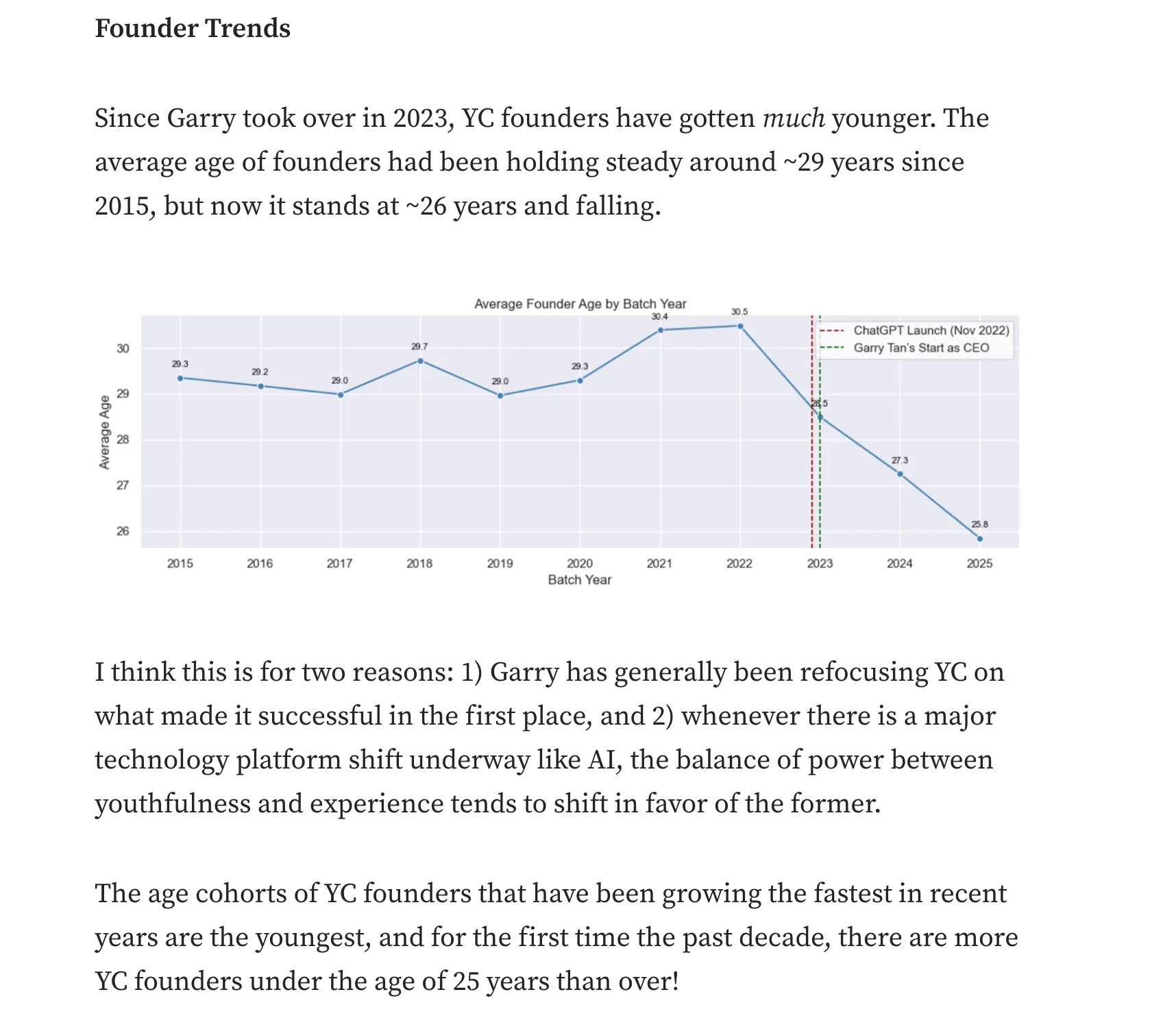
From Jared’s post mentioned above about YC average age by batch year
So what are the funds trying to accomplish by backing 20 year olds?
A lot of venture is pattern matching and trying to back enough founders that you have a better chance at the big return. We know every company can’t succeed. Companies shut down all the time and while it is hard as a fund to see it happen, it can really be life changing and demoralizing for founders. Especially ones that are so young it is the only thing on their resume. The good news is there’s nothing easier to back or hire than a second and third time founder. The bad news is no one tells founders this at the onset.
The expectations are a bit wild right now and frankly, not realistic. Startups and founders need time and space to cook. Funds are looking for revenue numbers in the millions within 12 months when we used to get excited about community growth instead of immediately focusing on revenue. Often seed funds would like to see $1M in ARR which used to be the metric we saw for raising an A. I wrote about this in Round Names are Meaningless Right Now and Redefining Round Names, Stretched Fundraising Timelines, and What’s on the Horizon for Technical Investing back in April.
But to sum it up, everyone is chasing the next Cursor. Cursor was built by a set of young, brilliant MIT founders that went from zero to $2B+ in revenue in 4 years (forecasting $6B by EOY). But that’s an atypical growth trajectory and not something you can benchmark against. I’ve said it over and over and over and over: You’re not raising the bar when you set outlier performance as the expectation.
Resetting founder and VC expectations and the myth of the young founder
Or more simply put, what do funds owe the younger generation of founders, if anything? I think it’s honesty and realistic expectations to go along with the capital. Space to grow. Not only the company but as founders and humans. And being clear that failure at the earliest stages is extremely normal.
Watch The Social Network or scroll LinkedIn for ten minutes. Nobody is posting about shutting down their company or not being able to raise their next round. The stories of failure, which are more prevalent and honestly more instructive than the wins, aren’t being told on the big screen. For a young founder who hasn’t watched peers go through the harder parts yet, that silence creates a distorted map. Not knowing what to be afraid of can be a strength. But so can the myth that if you build something great, it will succeed. Great products fail every single day. Shitty products make it.
The pressure young founders are putting on themselves right now is a direct product of that distortion. They’re measuring their private reality against everyone else’s public highlight reel and concluding they’re behind. They’re not behind. They’re just seeing the myth clearly for the first time and don’t have enough experience yet to know it’s not real and has been created through careful social media creation.
Investors have a responsibility here that not enough of them take seriously. The job is to find the winners and help them win, that’s what you owe to yourself and to your LPs. But good investors also understand what it means to be on the other side of that check for the majority of the portfolio that won’t break out. That looks like helping founders find a soft landing through an acquihire or acquisition, helping them think clearly about winding down, or just letting them keep going as long as they want to even if as a VC you can’t be as engaged as you were from day 0.
Ultimately it’s a founder’s decision when they’re done. As an investor, you can give advice. That’s it. The best thing you can do is be honest with them earlier than feels comfortable.